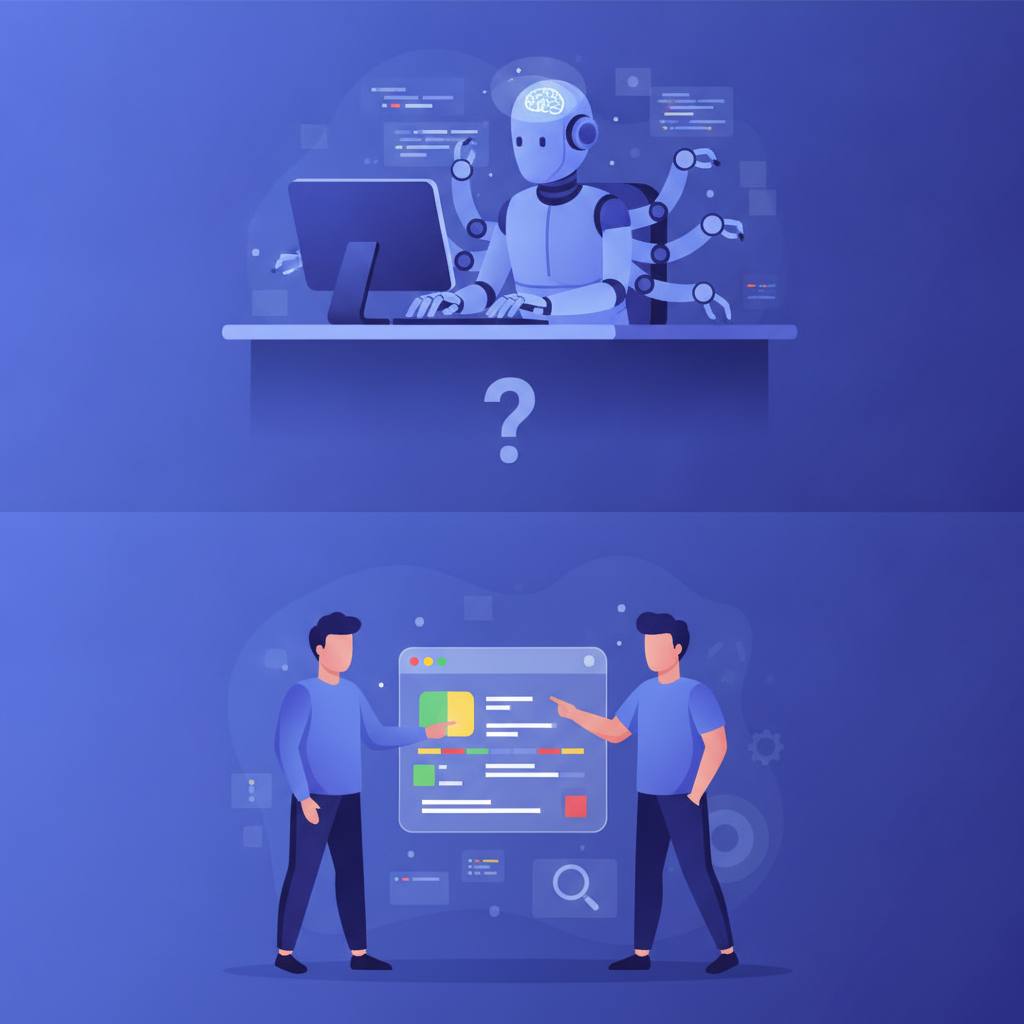
A Vietnamese CEO claimed AI replaced software developers for his internal tools at minimal cost. However, the engineering community exposed critical flaws in the AI-built application by simply opening developer tools.
A controversial story recently caused a huge stir in the tech world: can AI truly replace human software developers? So, what does this development really mean for you and the future of tech? It all started when a Vietnamese CEO posted a bold claim, stating he paid around $20/month for Claude AI, and it had replaced developers for his company’s internal software. He argued that small and medium businesses no longer needed expensive software developers or costly SaaS subscriptions. Instead, they could simply describe what they wanted in natural language, and AI would build it.
This post spread rapidly across social media, with thousands agreeing. Some celebrated it as the future of software development, while others saw it as the beginning of the end for software engineers. Everyone seemed to have an opinion. However, a few days later, something interesting happened. A handful of engineers managed to find the application behind the viral post. Out of curiosity, they did what engineers naturally do: they opened their web browser, hit F12, and explored the DevTools.
At first, nobody was trying to prove anyone wrong; they simply wanted to understand how it had been built. Then, the first screenshot appeared, raising an eyebrow: 'Wait... why is this exposed in the frontend?' A few minutes later, another: 'This credential shouldn't be here.' Then yet another: 'Is the admin page actually protected?' More engineers joined in, with some inspecting the JavaScript bundle, others monitoring network requests, and tracing API calls. Within hours, screenshots, code snippets, and technical analyses started spreading across engineering groups in Vietnam.
The conversation was no longer about whether AI could generate code. It had evolved into a much more interesting question: What's the difference between software that works and software that's ready for production? To be fair, the application looked surprisingly good. The UI was clean, authentication existed allowing users to log in, and data could be created. But what DevTools revealed was that the 'under-the-hood' work wasn't secure or professionally implemented enough. While AI can certainly generate functional code, creating a production-ready system—one that’s secure, maintainable, and robust—that’s a different story that still needs human ingenuity and expert oversight to handle real-world risks.
This post spread rapidly across social media, with thousands agreeing. Some celebrated it as the future of software development, while others saw it as the beginning of the end for software engineers. Everyone seemed to have an opinion. However, a few days later, something interesting happened. A handful of engineers managed to find the application behind the viral post. Out of curiosity, they did what engineers naturally do: they opened their web browser, hit F12, and explored the DevTools.
At first, nobody was trying to prove anyone wrong; they simply wanted to understand how it had been built. Then, the first screenshot appeared, raising an eyebrow: 'Wait... why is this exposed in the frontend?' A few minutes later, another: 'This credential shouldn't be here.' Then yet another: 'Is the admin page actually protected?' More engineers joined in, with some inspecting the JavaScript bundle, others monitoring network requests, and tracing API calls. Within hours, screenshots, code snippets, and technical analyses started spreading across engineering groups in Vietnam.
The conversation was no longer about whether AI could generate code. It had evolved into a much more interesting question: What's the difference between software that works and software that's ready for production? To be fair, the application looked surprisingly good. The UI was clean, authentication existed allowing users to log in, and data could be created. But what DevTools revealed was that the 'under-the-hood' work wasn't secure or professionally implemented enough. While AI can certainly generate functional code, creating a production-ready system—one that’s secure, maintainable, and robust—that’s a different story that still needs human ingenuity and expert oversight to handle real-world risks.