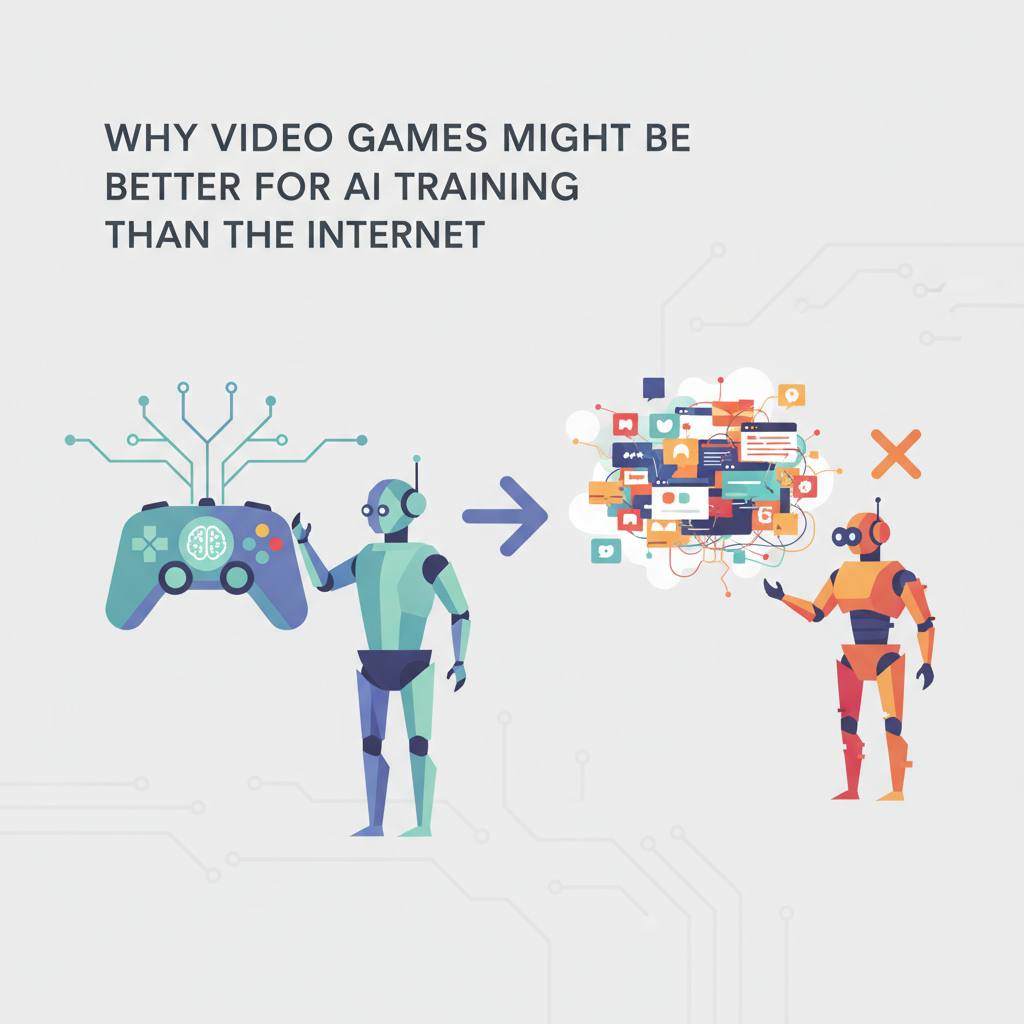
A tech CEO suggests video game data offers superior training for AI, especially for understanding how objects move through space and time, a crucial step beyond current large language models for achieving true Artificial General Intelligence (AGI).
What if the secret to building truly smart AI lies not in vast internet data, but in the virtual worlds of video games? That's the intriguing idea put forward by a CEO from a new startup, who believes gaming data could be far more effective for training AI than the endless information found on the internet.
The core of the discussion revolves around Artificial General Intelligence (AGI) – the ambitious goal of creating AI that can perform any intellectual task a human can. While large language models like ChatGPT and Claude are incredibly skilled at processing text, they often struggle with a fundamental understanding of how things actually move and exist in the real world, through space and time. Imagine an AI that needs to pick up a cup without dropping it, or navigate a cluttered room. These essential skills for generalized intelligence are often missing from models trained primarily on text.
This is where video games come into play. They provide rich, simulated 3D environments where objects move and interact under specific physics rules. An AI trained on this kind of data can learn about spatial reasoning, movement, and cause-and-effect in a much more hands-on, realistic way. This training can give AI the 'general intuition' about how the world works that text-based models often lack.
So, what does this mean for you? It could mean we're on the cusp of seeing AI advancements that go beyond just answering questions or writing essays. This approach might lead to the development of much smarter robots capable of handling complex real-world tasks, or AI systems that can design physical products with a deeper understanding of their mechanics. In essence, it could result in AI that truly understands the physical world around us, potentially changing how we interact with technology in our daily lives in ways we've not yet imagined.
The core of the discussion revolves around Artificial General Intelligence (AGI) – the ambitious goal of creating AI that can perform any intellectual task a human can. While large language models like ChatGPT and Claude are incredibly skilled at processing text, they often struggle with a fundamental understanding of how things actually move and exist in the real world, through space and time. Imagine an AI that needs to pick up a cup without dropping it, or navigate a cluttered room. These essential skills for generalized intelligence are often missing from models trained primarily on text.
This is where video games come into play. They provide rich, simulated 3D environments where objects move and interact under specific physics rules. An AI trained on this kind of data can learn about spatial reasoning, movement, and cause-and-effect in a much more hands-on, realistic way. This training can give AI the 'general intuition' about how the world works that text-based models often lack.
So, what does this mean for you? It could mean we're on the cusp of seeing AI advancements that go beyond just answering questions or writing essays. This approach might lead to the development of much smarter robots capable of handling complex real-world tasks, or AI systems that can design physical products with a deeper understanding of their mechanics. In essence, it could result in AI that truly understands the physical world around us, potentially changing how we interact with technology in our daily lives in ways we've not yet imagined.